England
The Man Who LaughsEngland is more than the geographical setting of the story: it is the political and legal order that determines who may rule, who may inherit, and who can be silenced. Its history moves from Oliver Cromwell’s republic through the Restoration of the monarchy to Queen Anne’s reign, while its institutions preserve and enforce distinctions of rank. Against that background, the fate of Linnæus, Lord Clancharlie and the later recovery of Gwynplaine’s birthright reveal how royal authority and inherited privilege can shape individual lives.
Political history and the Restoration
England’s political history is presented as a succession of reversals rather than a settled progression. Linnæus, Lord Clancharlie, a peer contemporary with Cromwell, accepted the republic and remained faithful to it after the parliamentary government fell. When the monarchy returned under Charles II, he could have resumed his place in the House of Lords by swearing allegiance to the king. Instead, he refused and voluntarily went into exile. In a country celebrating the Restoration, his continued loyalty to the defeated republic made him appear an anachronism and invited ridicule.
The narrative sets Clancharlie’s private refusal against the public enthusiasm for Charles II. The king is described as amiable and admired, and the returning monarchy as a source of reconciliation and national celebration. Those who rallied to the restored throne could receive office and reward; Clancharlie, by contrast, chose exile over accommodation. The contrast makes political allegiance consequential not only as an abstract conviction but as a decision about access to country, title, and public standing.
The account of the Restoration also stresses the speed with which political memory is revised. The republic’s language of rights and liberty is treated with mockery once royal government is restored, while the executions of the regicides contribute to the public’s satisfaction with the new order. England’s renewed loyalty is represented as common sense, but the narrative’s irony draws attention to how readily political opinion follows victory. The country that had once challenged monarchy now celebrates its return and treats the former challenge as folly.
Rank, wealth, and social order
England’s hierarchy is expressed through both ceremony and punishment. The privileges assigned to different ranks include the right to a canopy for a duke in the king’s absence, a canopy in his own house for a viscount, and a particular cover used by a baron while drinking. A baroness, too, has a prescribed ceremonial distinction in the presence of a viscountess. Such minute gradations make rank visible in ordinary settings and present aristocratic status as a system of practical entitlements, not merely a name.
The social order is sharply unequal beyond questions of ceremony. The narrative describes a plebeian who strikes a lord as subject to the loss of his hand, while insisting that a lord stands very nearly on the level of a king and a king very nearly on the level of a god. Even the language used for the divine is drawn into the hierarchy: the English are said to address God as lord. The sequence links social deference to political and religious authority, showing how the vocabulary of obedience can make a human rank appear almost sacred.
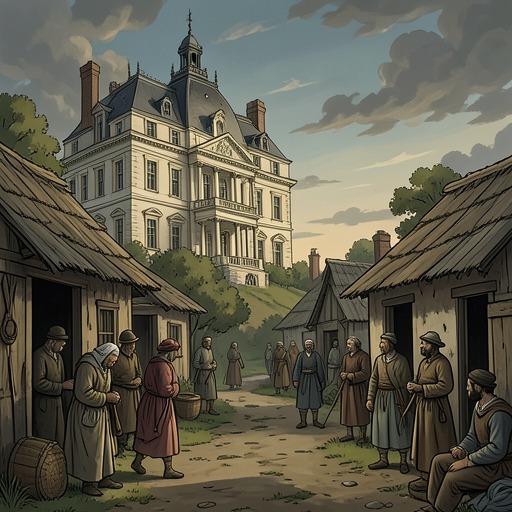
Wealth and public finance further expose the distance between ruler and ruled. The royal palace is described as serving eighty-six tables and five hundred dishes at every meal, while the account of Queen Anne’s England records the state’s military scale and its costs. In 1705 the fleet numbered 150 warships; English forces served in several European campaigns, and the country paid substantial sums to its allies. Such figures place royal and national grandeur alongside the narrative’s attention to the people who pay taxes and serve in the armed forces.
England under Queen Anne
Queen Anne’s reign is depicted as a period of political display and restricted liberty. Meetings required permission from two justices of the peace, and an assembly of twelve people could be treated as a felony even if they had gathered simply to eat and drink. The account also emphasizes the violent impressment of sailors for the fleet. These measures sit uneasily beside England’s older claims to freedom: the country could celebrate liberty while subjecting gatherings and ordinary people to coercive regulation.
The narrative extends its criticism to the laws against Ireland issued under Anne, describing them as severe. It also notes the limits of English liberty in practice, pointing to the imprisonment of public speakers in the Tower of London and the punishment of writers in the pillory. Rather than treating constitutional reputation as proof that people were free, this history measures liberty against the institutions that could restrain speech, assembly, and movement.
Anne’s England is also presented through its ambitions and its image of itself. The country had a large fleet, armies abroad, and growing military and overseas reach; it had recently annexed Scotland and was active in campaigns and naval operations. The comparison between Anne’s court and the court of Louis XIV casts English magnificence as a smaller-scale imitation of French grandeur. The court’s arts, public ceremony, military successes, and patronage produce an appearance of a great reign, but the comparison also underscores the constructed nature of that appearance.
Law, administration, and coercive power
The legal order in England is represented not as a single, uniform system but as a collection of overlapping powers and inherited practices. The narrative describes arrests carried out without explanation as common in the period, notwithstanding the Habeas Corpus Act. These silent arrests were understood as a way of withholding information while the authorities acted, and the account associates them with claims of state necessity. Its examples range across English political history, suggesting that the practice could serve different regimes rather than belonging exclusively to one form of government.
Local administration likewise combined royal authority with distinct offices and jurisdictions. Most county sheriffs received their commissions from the monarch; the sheriff of Westmoreland held the office hereditarily, while the sheriffs of London and Middlesex were elected by the livery in the common hall. A county sheriff was responsible for escorting and protecting judges on circuit, and officers under the sheriff apprehended, examined, and imprisoned accused people for trial. The account’s attention to these roles shows how royal power was carried into local life through a layered administrative structure.
The courts and prisons could also embody a harsher form of power. Gwynplaine’s experience brings him before a torture chamber, and the narrative notes that such chambers existed in England, including in prisons associated with the age of King John. Elsewhere, the legal procedure applied to Hardquanonne culminates in a fourth-day confrontation: after the bottle and its enclosed parchment have been presented, and after he has refused to answer, Gwynplaine is brought before him and Hardquanonne recognizes his victim. The procedure turns a secret history into evidence, but it does so within a system whose methods are shown as severe.
Inheritance, identity, and the country’s contradictions
England’s political order determines the consequences of the concealed Clancharlie history. After reports circulated that Linnæus, Lord Clancharlie had married Ann Bradshaw in exile and left a son, King James II declared Lord David Dirry-Moir heir in the absence of legitimate issue. The king’s grant tied that inheritance to a future marriage with the infant Duchess Josiana. The arrangement transferred the titles and their associated estate provisionally to Josiana, with David to become Baron Clancharlie if he married her. The episode shows hereditary status being managed through royal patents and marriage conditions as well as descent.
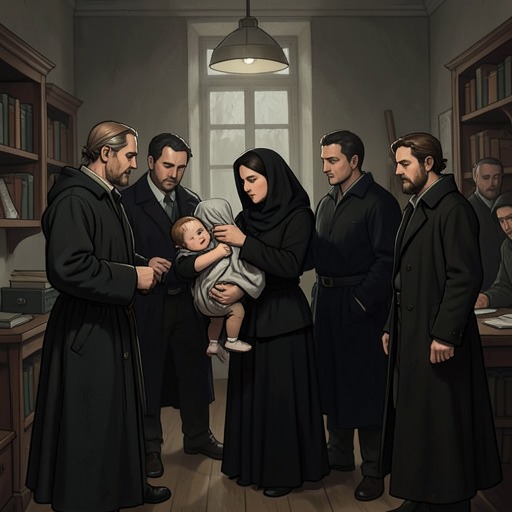
The later revelation that Gwynplaine is the legitimate son of Clancharlie and Ann Bradshaw overturns that official settlement. The parchment identifies him as the inheritor of his father’s estates and titles and states that he was sold and put out of the way so that he could not claim them. To establish the claim, documents from Switzerland confirm the marriage, the child’s birth, and the deaths of his parents; Hardquanonne’s recognition supplies a further link between the evidence and the person before the court. England’s legal machinery, first implicated in his dispossession, becomes the means by which his identity is publicly restored.
That reversal does not erase the larger contradiction in England’s institutions. Royal authority can register an inheritance and suppress the person who should possess it; legal process can then recognize the concealed heir, while its own procedures expose the harshness of the order administering justice. The country’s ceremonial privileges, restraints on assembly and speech, and rules of succession belong to the same political world. England therefore functions in the narrative both as the site where rank is protected and as the arena where the violence and instability behind that protection become legible.